Simple Agentic Methodology

S.A.M. Programming

Build fast and right with AI agents

With AI agents, a large project no longer moves at the pace of a dev team. It moves at the pace of your decisions.

Agents code several tickets at once, day and night, and deliver continuously. The risk is no longer moving too slowly, it is producing lots of code nobody controls. S.A.M. organizes the work so agents go fast and get it right.

In parallel

Each agent takes a ticket. Ten tickets, ten agents, at the same time.

Day and night

Agents code at night. In the morning, humans test the beta.

Zero meetings

No stand-ups, no task assignment: agents pick their own tickets.

At scale

Project growing? Add agents, not meetings. Very large project: one duo per module.

01

The bottleneck has moved

Coding time is now close to zero. Everything happens before (deciding) and after (validating).
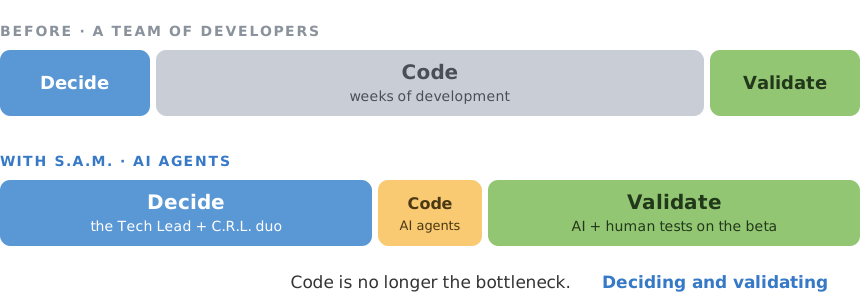
Before, coding took most of the time. With AI agents, deciding and validating do.
02

2 humans + AI agents

No project manager, no dev team. A duo decides, agents execute.
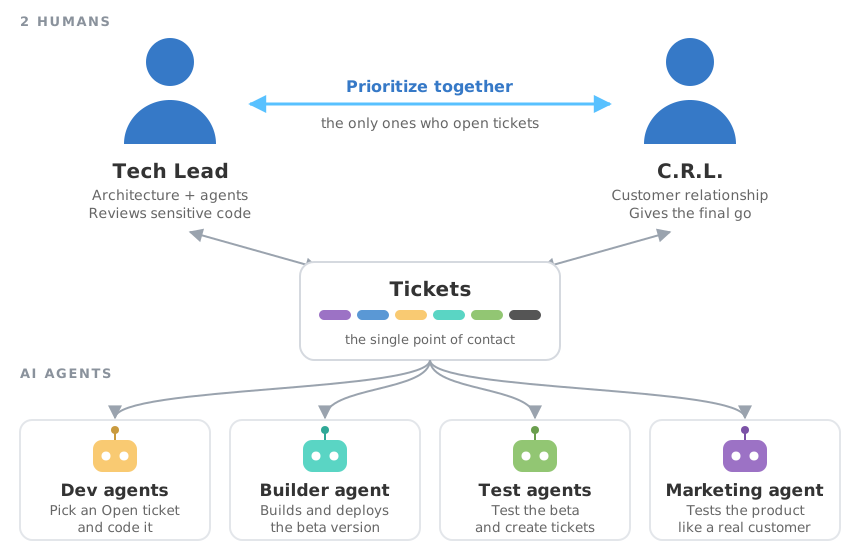
The Tech Lead and the C.R.L. prioritize together; dev, builder, test and marketing agents work from the tickets.
Technical vision

Tech Lead

  • Prioritizes with the C.R.L.
  • Connects the product to its agents
  • Reviews sensitive code
  • Keeps the architecture consistent
Customer vision

C.R.L. Customer Relationship Lead

  • Prioritizes with the Tech Lead
  • Writes the acceptance criteria
  • Brings back customer feedback
  • Gives the final go

Why a duo? A salesperson alone asking an AI for an app misses the technical side. A tech alone misses the customer. Together, they prioritize right.

The Tech Lead's real job: connecting the product to its agents
Context Project rules and architecture written for the agent
Standards Style, types and formatting checked by tools
Tests & CI The safety net that lets the agent work alone
Beta A complete environment with realistic data
Permissions What the agent can touch, and what is off-limits
03

The life of a ticket

No more assignment: the ticket status tells who acts next.
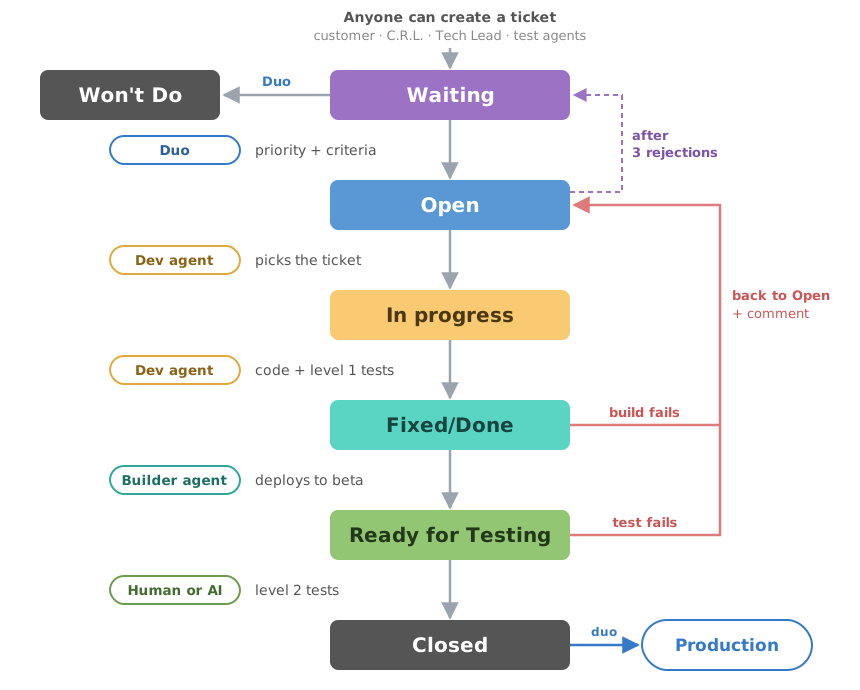
Ticket life cycle: Waiting, Open, In progress, Fixed/Done, Ready for Testing, Closed, with returns to Open on failure.
04

Two levels of testing

The first one filters, the second one validates.

1

By the agent that wrote the code

  • Before moving to Fixed/Done
  • On its own code
  • Fast, automatic
A filter, not a validation
2

By a human or another AI

  • On the beta, full product
  • With realistic data
  • Catches tickets that break each other
The real validation → Closed

Whoever writes the code doesn't validate it.

05

Guardrails

Five rules to keep agents fast without going off track.

  • 1
    Only the duo opens a ticketWaiting → Open. Otherwise agents start creating work for each other.
  • 2
    In progress = lockOne agent per ticket. No activity for a few hours: back to Open.
  • 3
    3 rejections = back to WaitingThe ticket is unclear or too hard for the agent: the duo takes it back.
  • 4
    Too many Ready for Testing? Stop openingThe limit is no longer code, it is what the duo can validate.
  • 5
    Emergency = immediate buildThe builder doesn't wait for its next run.
06

Principles

Nine principles for working efficiently with AI agents.

Respond to change

Change costs almost nothing: build two versions and pick one.

Simplicity

An agent arriving with no context must understand the code.

Continuous prioritization

The duo keeps reordering tickets, based on customers and tech.

Agents serve themselves

No assignment: the agent picks the highest-priority Open ticket.

One mistake = one rule

Every correction is written into the agent's rules. Never explain twice.

Whoever codes doesn't validate

Validation comes from another agent or a human.

Risk-based review

Auth, payments, data: Tech Lead review. Everything else: tests + C.R.L.

Checked standards

A rule no tool checks doesn't exist for an agent.

Continuous beta

Every finished ticket goes to beta and is tested in the full product.

07

Priorities

Agents always pick the highest-priority ticket.

EmergencyStop everything, the builder runs right away.
UrgentMust be in the next release.
HighPlanned for the next release.
NormalDuring the project cycle.
LowWhen nothing else is left.

S.A.M. in uBugtrack

The ticket statuses and priorities on this page are the ones uBugtrack uses. Your agents can list, create and update tickets through the uBugtrack API.

S.A.M. Programming: the method for building software with AI agents.

uBugtrack - Built with ♥ by a passionate small team located in Nice, France.
Plans & pricing - AI Agents (MCP) - News & Changelog - uBugtrack API - Simple Agentic Methodology - Privacy - Status
Follow on twitter